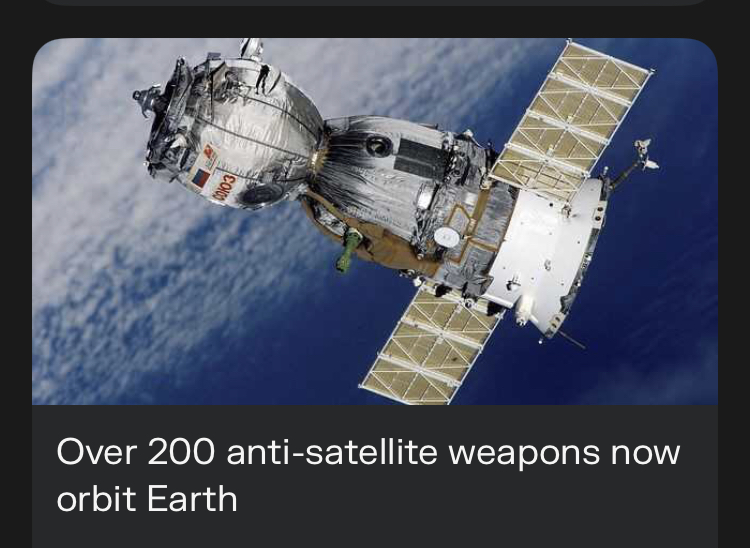
Space Militarization: Over 200 Anti-Satellite Weapons Now Orbit Earth
By AyroTv News Desk
The race to dominate outer space has taken a dangerous turn. Reports confirm that more than 200 anti-satellite (ASAT) weapons are now orbiting Earth, raising urgent concerns about the militarization of space and the risks it poses to global security.
What Are Anti-Satellite Weapons?
Anti-satellite weapons are systems designed to disable or destroy satellites in orbit. They can be launched from the ground, carried by aircraft, or even deployed directly in space. While nations justify them as defensive tools, their presence threatens the stability of space as a shared domain for communication, navigation, and scientific exploration.
Why This Matters
- 🛰️ Global Dependence on Satellites: From GPS navigation to internet connectivity, satellites are essential to modern life. Their destruction could disrupt economies, communications, and even humanitarian aid.
- ⚔️ Rising Tensions: The deployment of ASAT weapons reflects growing competition among major powers, particularly the United States, Russia, China, and India.
- 🌍 Collateral Risks: Destroying satellites creates dangerous space debris, which can damage other spacecraft and threaten astronauts aboard the International Space Station.
The Bigger Picture
The presence of over 200 ASAT weapons highlights a troubling reality: space, once seen as a frontier for exploration and cooperation, is increasingly becoming a battlefield. This shift risks undermining decades of international agreements that sought to preserve space as a peaceful domain.
AyroTv Perspective
At AyroTv, we believe this development is not just about technology or geopolitics—it is about the future of humanity’s shared sky. Just as Somali seafarers once navigated the Indian Ocean with trust in the stars, today’s world relies on satellites orbiting above us. If those stars of technology are turned into targets, the consequences will be felt by every community on Earth.
Looking Ahead
Calls are growing for renewed international treaties to limit the weaponization of space. Without cooperation, the risk of conflict in orbit could escalate into crises that affect life on the ground. The question remains: will world powers choose competition or collaboration in the final frontier?
Would you like me to expand this into a feature analysis—for example, connecting the militarization of space to Africa’s role in advocating for peace and neutrality in global conflicts? That could give AyroTv’s audience a unique, culturally rooted perspective.