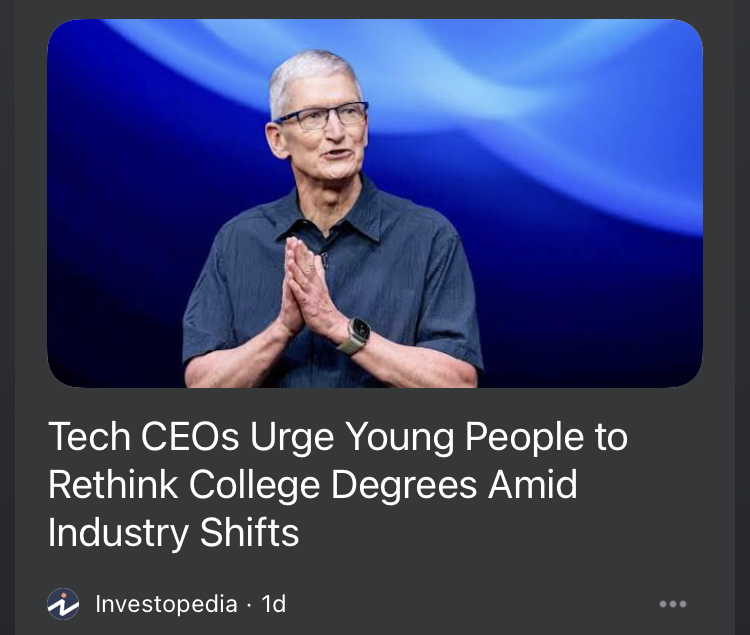
Tech CEOs Urge Young People to Rethink College Degrees Amid Industry Shifts
A growing chorus of influential tech leaders is challenging the long-held assumption that a four-year college degree is the only—or even the best—pathway to a successful career in the technology sector.
In a significant shift reflecting the industry’s rapid evolution, prominent CEOs are increasingly advocating for alternative routes such as vocational training, specialized certifications, and self-taught skills. This movement questions the return on investment of a traditional bachelor’s degree as the tech world prioritizes demonstrable skills and practical experience over formal education credentials.
The driving force behind this trend is a combination of factors: the soaring cost of higher education, the perceived slow pace of academic curriculum updates, and a persistent gap between the skills taught in universities and those desperately needed in the fast-moving tech landscape.
“Companies are struggling to find talent with expertise in cutting-edge fields like artificial intelligence, cybersecurity, and cloud infrastructure,” said a recent industry report. “Many are finding that a candidate’s portfolio of projects and proven abilities often outweighs the line on their resume listing a degree.”
The Executive Perspective
While the image does not specify the CEOs, this sentiment echoes recent public statements from several tech luminaries. Figures like Elon Musk (CEO of Tesla and SpaceX) and Phil Libin (co-founder of Evernote and All-Tome) have previously stated that exceptional talent can be found outside the traditional university system. Similarly, Apple CEO Tim Cook has emphasized that about half of Apple’s U.S. hires in recent years did not have a four-year degree, noting that “we have always believed that what you do is more important than where you went to school.”
The argument centers on skills-based hiring. Tech leaders posit that what matters most is an individual’s ability to code, design, analyze data, or manage projects—skills that can be acquired through bootcamps, online courses, and hands-on experience.
A Nuanced Debate
This push away from degree requirements does not signal the outright “death of college.” Proponents of higher education argue that the college experience provides critical soft skills, such as critical thinking, complex problem-solving, and communication, that are harder to quantify but invaluable in a professional setting. Degrees in computer science and engineering from top institutions still carry significant weight and provide a deep theoretical foundation.
However, the message from the industry is clear: the monopoly of the four-year degree as the sole ticket to a tech career is over. For many young people, the future may involve a more hybrid approach—mixing formal education with targeted skill-specific training—or forgoing university altogether in favor of more direct and affordable pathways to employment.
As the industry continues to shift, the onus is now on both educators and employers to adapt, ensuring that the next generation of talent is equipped with the right tools to thrive, regardless of how they acquired them.