Date: April 2, 2026
By: AyrOTV.com News Desk
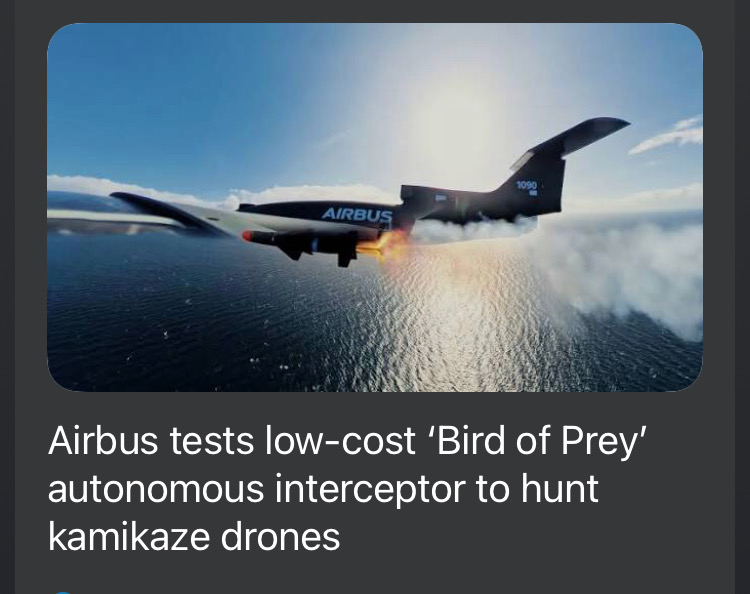
In a significant step toward affordable air defense, Airbus Defence and Space has successfully completed the first demonstration flight of its new “Bird of Prey” autonomous interceptor, specifically designed to counter low-cost kamikaze drones.
The live-fire test, conducted on March 30 at a military training range in northern Germany, saw the uncrewed drone autonomously search for, detect, classify, and engage a simulated medium-sized one-way attack drone using a lightweight Mark I air-to-air missile developed by Estonian defense startup Frankenburg Technologies.
A Nine-Month Sprint to Counter the Drone Threat
The Bird of Prey project has moved with remarkable speed, transitioning from an initial concept to a flight-ready prototype in just nine months. This accelerated timeline reflects a growing urgency among Western militaries and defense firms to develop cost-effective solutions against the rising tide of inexpensive one-way attack drones, which have proven highly effective in recent conflicts in Ukraine and the Middle East.
These inexpensive drones, such as Iran’s Shahed series, can often cost just a fraction of the traditional surface-to-air missiles used to intercept them, creating a severe economic imbalance for defenders[reference:6]. The Bird of Prey system is designed to directly address this challenge.
How the Bird of Prey Works
The interceptor drone is based on a modified version of Airbus’s jet-powered Do-DT25 target drone, which has a published maximum speed of approximately 555 km/h (300 knots). The prototype has a wingspan of 2.5 meters, a length of 3.1 meters, and a maximum takeoff weight of 160 kilograms.
During the test, the Bird of Prey carried four Mark I missiles, though the planned operational version is expected to be capable of carrying up to eight.
At the heart of the system is the Mark I missile itself. Described as a high-subsonic, fire-and-forget interceptor, it is among the lightest guided missiles ever developed[reference:11]. The missile measures just 65 centimeters in length, weighs less than 2 kilograms, and has an engagement range of up to 1.5 kilometers[reference:12]. It is equipped with a fragmentation warhead designed to neutralize its target at close proximity.
Strategic Implications and Cost-Effectiveness
The system’s primary value lies in its ability to invert the economic cost curve of modern air defense. By using a reusable drone equipped with multiple, relatively inexpensive missiles, the Bird of Prey can engage and neutralize several hostile drones in a single mission at what the companies describe as a “comparably low cost per kill”.
Airbus Defence and Space CEO Mike Schoellhorn underscored the system’s strategic necessity, stating, “Against the current geopolitical and military backdrop, defending against kamikaze drones is a tactical priority that urgently needs to be tackled”. He added, “With our Bird of Prey and Frankenburg’s affordable Mark I missiles, we are providing armed forces with an effective, cost-efficient interceptor, filling a crucial capability gap in today’s asymmetric conflict theatres”.
Echoing this sentiment, Frankenburg Technologies CEO Kusti Salm called the successful demonstration a “defining step for modern air defence,” noting that it “marks the first integration of a new class of low-cost, mass-manufacturable interceptor missiles onto a drone, creating a new cost curve for air defence”.
Integration into NATO Air Defense Networks
A key feature of the Bird of Prey is its design for seamless integration into NATO’s integrated air defense architecture. The system will operate through Airbus’s Integrated Battle Management System (IBMS), allowing it to act as a highly mobile and complementary component of any integrated, layered air and missile defense solution.
Future Testing and Operational Outlook
Airbus and Frankenburg have announced plans for additional test flights throughout 2026. These future tests will include live-warhead demonstrations designed to further operationalise the system and prove its full capabilities to potential buyers.
With a compressed development cycle, a clear operational concept, and a focus on economic sustainability, the Bird of Prey appears poised to become a significant new tool in the effort to counter the growing threat of mass drone attacks.