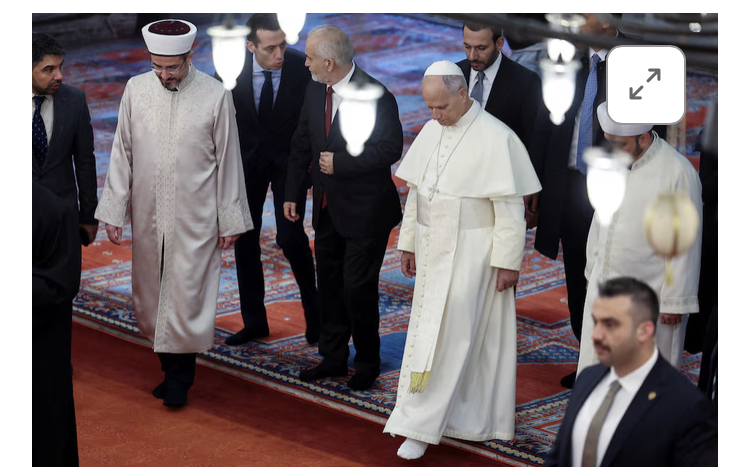
Pope Leo XIV removes shoes but declines to pray in a visit to Istanbul’s Blue Mosque
They call him “Vatican Bob.” It’s a nickname earned over three decades as a curator and historian within the hallowed halls of Vatican Museums. His life’s work has been to understand the art, architecture, and soul of Christendom’s most iconic state. So, when he announced his holiday would be in Istanbul, his colleagues were intrigued. When he said his first stop was the Süleymaniye Mosque, they were astonished.
“I’ve spent my life surrounded by the grandeur of Bernini and Michelangelo,” Bob explained, adjusting his well-worn sun hat. “I thought it was time to understand the other great pillar of religious art in the Mediterranean. To see the divine expressed in a different architectural language.”
And so, I found myself following Vatican Bob not into a basilica, but into the serene courtyard of the Süleymaniye, a masterpiece of the Ottoman architect Mimar Sinan. The transition was jarring, even for me. The bustling, tourist-thronged streets of Istanbul simply fell away, replaced by an ablution fountain and a quiet, sweeping plaza.
Bob, however, didn’t skip a beat. He approached the shoe storage with the respectful demeanor of a man used to sacred spaces. He observed the visitors wrapping shawls around their waists, and he did the same with a quiet efficiency. This was not a tourist checking a box; it was a scholar entering a new library.
As we stepped into the cavernous prayer hall, I watched his face. The man who works beneath the Sistine Chapel ceiling every day simply stood still. His eyes, accustomed to the vibrant narratives of Biblical frescoes, were now taking in an entirely different theology of space.
“Fiat lux,” he whispered, the Latin for “Let there be light.”
He wasn’t looking at the walls, but upward. He was tracing the paths of light streaming from the countless windows, illuminating the vast, unadorned central dome. “Michelangelo uses light theatrically, to highlight the drama of creation and judgment,” he mused, his voice low. “Here, Sinan uses light as the primary decoration. It is… the presence of God itself. No idols, no representation. Just space, pattern, and divine illumination.”
He pointed out the supporting pillars, seamlessly integrated into the walls. “He’s hiding the engineering,” Bob said with a curator’s grin. “Just as we hide the scaffolding in St. Peter’s. The goal is to make the divine seem effortless, weightless.”
For twenty minutes, he simply walked the perimeter, his fingers not touching, but hovering near the exquisite Iznik tiles. “They are like illuminated manuscripts in ceramic,” he noted. “The floral patterns, the endless repetition… it’s a visual chant. It doesn’t tell a story like a stained-glass window; it invokes a state of being.”
We sat on the deep crimson carpets. Bob observed a small group of men performing their afternoon prayers, their movements a unified, gentle rhythm.
“In the Vatican, the focus is often on the Papal altar, the central authority,” he reflected. “Here, the focus is on a direction—the qibla. The community aligns itself together, in unison, toward Mecca. It’s a powerful architectural expression of unity and submission. It’s profoundly beautiful.”
Walking out, blinking in the afternoon sun, Bob was silent for a long time.
“Well?” I finally asked.
He smiled, a thoughtful, contented look on his face. “We spend our lives becoming experts in our own cathedrals, thinking we understand the whole of sacred art. But it’s like only ever reading one book in a vast library. Today, I read a few pages of another. The grammar was different, the vocabulary unfamiliar, but the central theme… the yearning for the eternal, the use of human genius to point toward the divine… that was comfortingly, magnificently the same.”
Vatican Bob didn’t have a conversion experience that afternoon. He had something perhaps more valuable: a deepening. He returned to his world beneath the frescoes of Michelangelo with his understanding of faith, art, and humanity expanded, his own cathedral now framed by the elegant, silent dome of Sinan.